Paso Robles school board spending dispute sparks calls for censure
By Hayley Mattson · Fri Nov 13 2026
Trustees defend administrators, Enney denies misleading the public, and district reports nearly $86,000 in public records-related costs
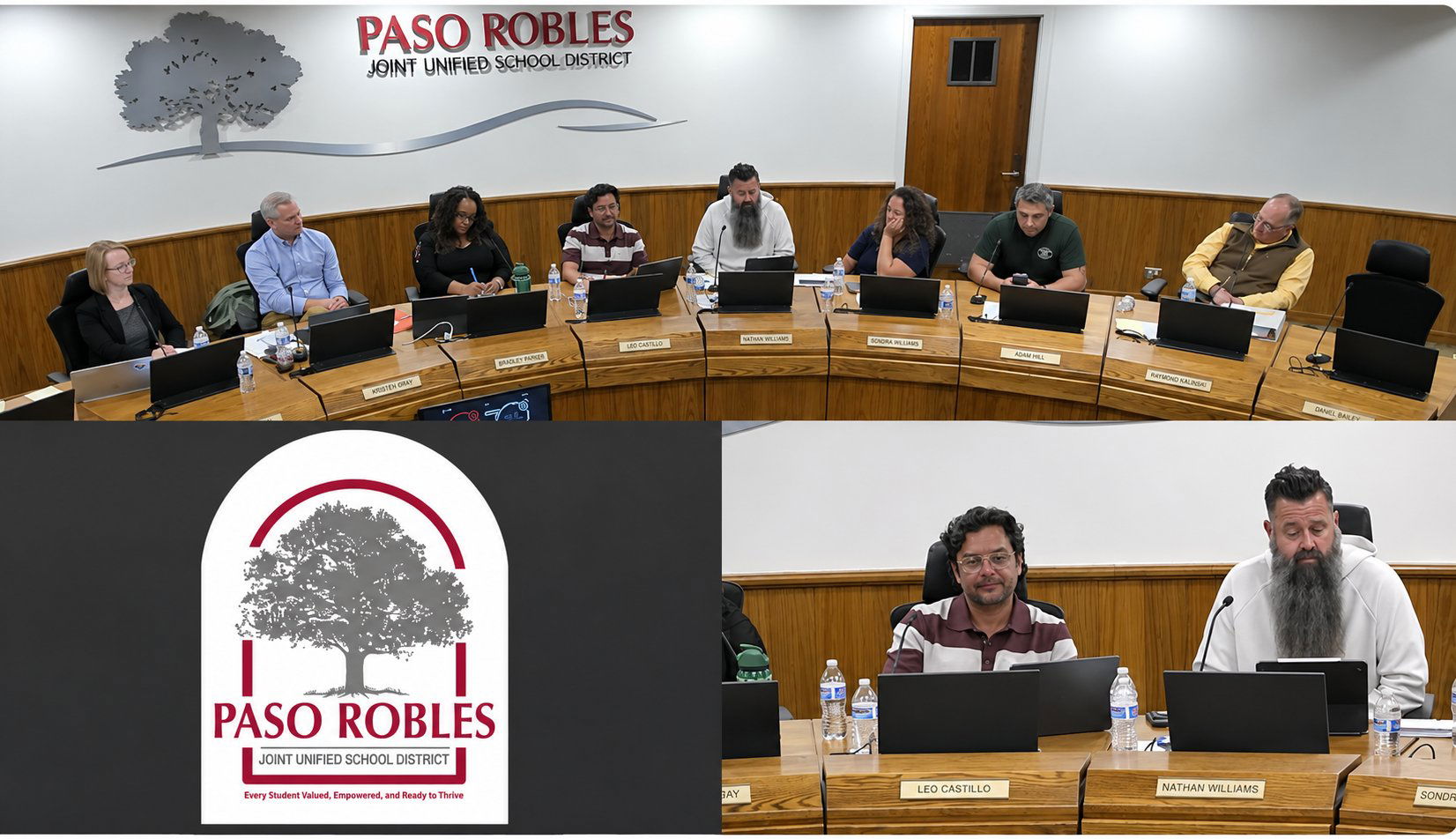
PASO ROBLES — A dispute over district credit card spending intensified at Tuesday night’s Paso Robles Joint Unified School District board meeting, where community members urged trustees to censure Kenney Enney, Trustee Nathan Williams called for a formal review of conduct surrounding the allegations, and Enney denied lying about the expenditures. The Nov. 10 meeting also included a presentation on the district’s growing volume of California Public Records Act requests. District representative Rebecca Justice reported approximately $85,782 in records-related costs since January, including $17,367.72 in legal fees associated with responding to a separate Fair Political Practices Commission matter.
The discussions brought together questions about spending oversight, access to public records, and trustees’ responsibilities when communicating allegations involving district employees.
As of Nov. 11, no findings from the district’s announced independent spending investigation had been publicly released, and a district attorney investigation remained unconfirmed. The district’s posted statements do not identify the investigator, disclose a contract amount, or provide a completion date.
Williams said he supported investigating suspected misuse of public funds but also wanted scrutiny of how accusations had been presented.
“No employee, administrator, or elected official should be exempt from appropriate scrutiny,” Williams said.
He urged the board to review documented public statements and conduct surrounding the controversy, with guidance from independent legal counsel where appropriate.
“If the evidence establishes conduct warranting formal disapproval, I believe a resolution of censure should be considered through a fair and transparent process,” he said.
The controversy stems from Enney’s referral to the San Luis Obispo County District Attorney’s Office asking for review of administrators’ credit card purchases. His complaint questions whether expenditures complied with district purchasing rules or constituted misuse of public funds.
The district announced Nov. 2 that it had retained an independent investigator. In expanded statements released Nov. 6, Superintendent Jennifer Loftus and Board President Joel Peterson said several questioned expenses involved donor-funded staff events and authorized district travel.
District leaders said private donations covered winery venue fees for an annual staff celebration. Loftus also said Chief Business Officer Brad Pawlowski’s questioned Bakersfield meal expenses were connected to his official responsibilities with Self-Insured Schools of California, rather than separate consulting work.
Those explanations remain subject to the announced review. The district has pledged to release the findings and investigation cost.
Williams said trustees have obligations both to pursue oversight and to distinguish allegations from established facts.
“Trustees have a responsibility to ask difficult questions and pursue legitimate oversight,” he said. “We also have a responsibility to communicate accurately, distinguish suspicion from proof, and avoid unnecessarily damaging the professional reputations of the people who serve our students.”
He said contacting oversight agencies and questioning expenditures are legitimate accountability functions. His concern, he said, was whether those responsibilities had been exercised consistently with the public trust.
During public comment, Sarah Kramer expressed support for district leadership and encouraged respectful disagreement.
“While no organization is perfect and every leader should be held accountable, that accountability should be exercised in a way that helps move the district forward rather than pulling it apart,” Kramer said.
She said continuing controversy could undermine confidence in the district and distract from classroom work.
“Our students are watching how adults handle disagreement,” Kramer said.
Another speaker read a statement she said was signed by herself and other community members urging the board to censure Enney. The statement accused him of circulating allegations based on incomplete information and argued that public accusations had damaged administrators’ reputations and diverted district resources.
Those were the commenters’ assertions, rather than findings from the independent investigation.
The district’s public records presentation added another point of contention.
Justice said responding to requests can involve locating documents, retrieving offsite files, reviewing records, making permissible redactions, corresponding with requesters and obtaining legal assistance.
Some requests seek readily available reports, she said, while others involve extensive documentation or communications.
Justice identified requests from Baker concerning aquatics complex expenses, CalCard records and board training expenses as requiring substantial staff time. She said the CalCard request involved receipts, card logs, and other documentation, some stored offsite.
She also described repeated requests from an organization identified as Data Branch seeking purchase orders, contracts and related records, along with requests from other individuals involving employee information, bond documents, and communications.
A recent request from Enney sought district and personal communications concerning Measure G, Justice said. Staff time and legal costs for that request had not yet been determined.
Justice reported 39 requests between July 1 and Nov. 1 and said three more had arrived after the presentation was prepared. She projected that the district could receive 117 requests over the full year if the pace continued.
Peterson asked whether the work was being contracted out or handled by existing employees.
“No, this is all in-house, currently in-house staff that is doing that,” Justice said, explaining that responding to requests draws time from employees’ other duties.
When Peterson asked whether the approximately $85,782 in reported costs covered three years or the current year, Justice clarified that the figure covered the period beginning in January 2026.
The presentation did not establish how much of that total was attributable specifically to the CalCard requests. The figure also should not be read as the cost of the independent spending investigation, which the district has not disclosed.
Justice separately discussed a sworn complaint Baker submitted to the Fair Political Practices Commission alleging a violation of the Political Reform Act’s mass mailing provisions.
She said the commission found no violation and that related legal fees totaled $17,367.72. The underlying commission disposition was not included in the material reviewed for this report, so that account is attributed to the district.
That complaint concerned mass mailing rules, a separate issue from whether administrators’ credit card purchases complied with applicable requirements.
Board Clerk Laurene McCoy criticized the expense associated with the FPPC matter and later directly challenged Enney’s conduct, accusing him of bullying administrators and circulating false statements.
McCoy said the controversy had harmed employees and their families and overshadowed district progress. Her characterization of the spending allegations as untrue was her assessment, rather than an announced investigative finding.
Trustee Leo Castillo also defended district employees, saying he was proud of their work and would continue supporting their reputations.
“I commend you all for all the hard work you have done,” Castillo said.
Enney objected after McCoy’s remarks.
“You don’t call me a liar,” he said, invoking a point of privilege and seeking to respond because she had addressed him directly.
“You let the investigation come out, look at the facts,” Enney said. “I didn’t lie about anything.”
Enney previously said he had raised concerns about CalCard spending during board meetings since 2023. In a public letter, he called for an outside forensic audit and argued that a routine audit or district-controlled review would be insufficient.
District leaders have disputed his handling of the complaint, saying he submitted it to outside agencies and shared it publicly before bringing the complaint to the district.
The competing accounts leave unresolved what specific concerns Enney previously raised, what documentation was available or provided in response, and whether public descriptions accurately reflected the underlying transactions.
Tuesday’s public records presentation described the workload associated with requests but did not clarify whether all supporting records sought for the questioned CalCard purchases had been produced.
The independent investigation’s findings, supporting transaction records, and any future board action remain central to resolving the dispute.
“Our community deserves accurate information. Our employees deserve fair treatment,” Williams said. “And our students deserve a board that remains focused on their education and well-being.”