County Health Officials Explain State's Metrics and Progressing into the Red Tier
By Paso Robles Press · Wed Feb 24 2021
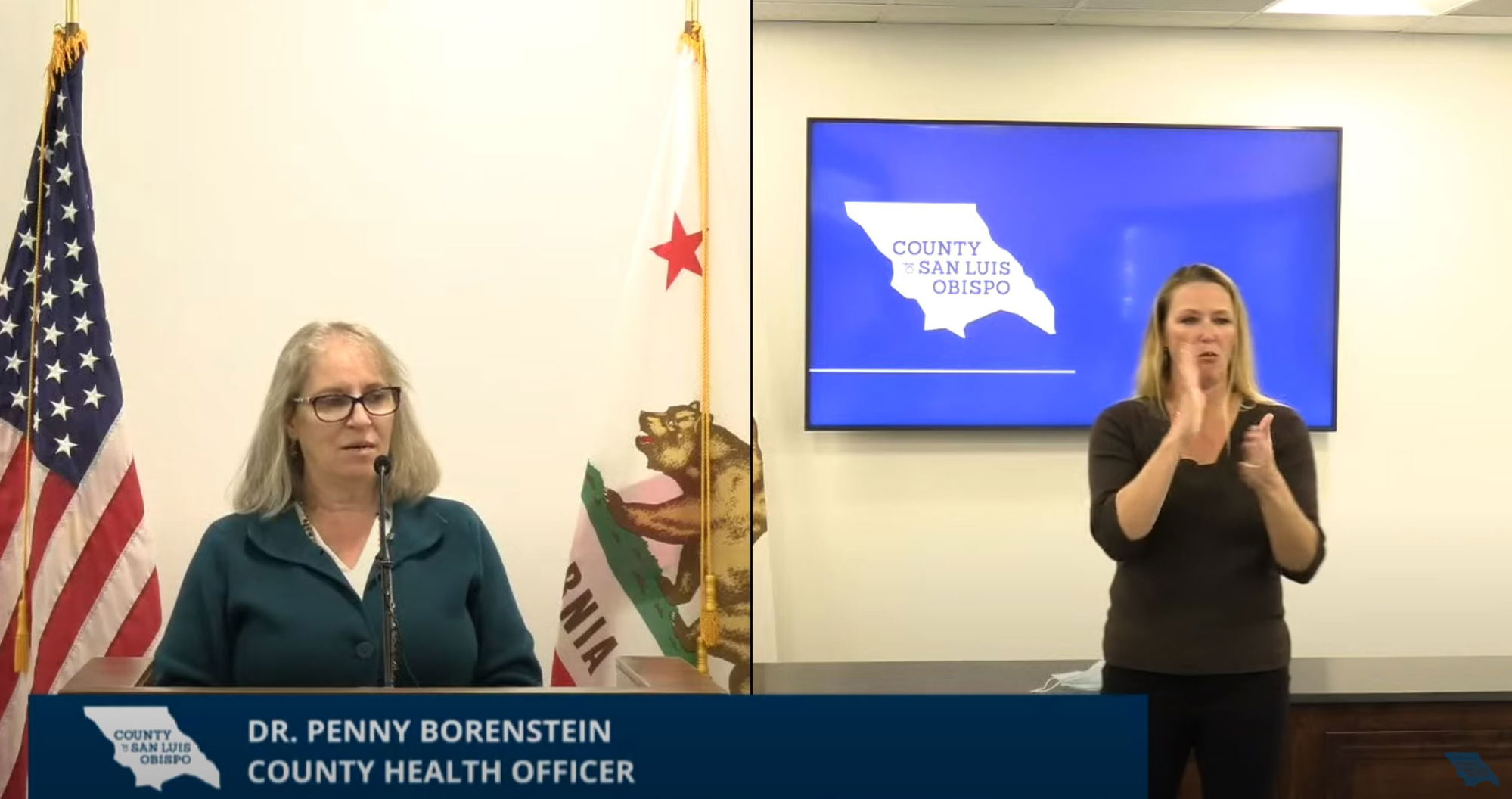
Borenstein states that increasing the number of tests conducted in SLO County could move the County faster through the tiers
SAN LUIS OBISPO — The California Department of Public Health (CDPH) released the most recent statistics on COVID-19, including updated data and tiers for reducing COVID-19 in the state under the Blueprint for a Safer Economy.
Five counties moved to a less restrictive tier, from Purple (widespread) to Red (substantial): Humboldt, Marin, San Mateo, Shasta, and Yolo. Marin and Shasta were moved due to the blueprint's Health Equity Metric. One County, Trinity, moved to a more restrictive tier, from Orange (moderate) to Red (substantial).
Forty-seven counties remain in the Purple (widespread) Tier, where San Luis Obispo County remains, nine in the Red (substantial) tier, and two remained in the Orange (moderate) tier.
Statewide COVID-19 Data as of Today
- California has 3,455,361 confirmed cases to date. Numbers may not represent true day-over-day change as reporting of test results can be delayed.
- There were 5,303 newly recorded confirmed cases Tuesday.
- The 7-day positivity rate is 3.1 percent, and the 14-day positivity rate is 3.2 percent.
- There have been 47,652,172 tests conducted in California. This represents an increase of 138,805 during the prior 24-hour reporting period.
- As case numbers continue to rise in California, the total number of individuals who will have serious outcomes will also increase. There have been 49,877 COVID-19 deaths since the start of the pandemic.
- As of Feb. 24, providers have reported administering a total of 7,763,668 vaccine doses statewide. Numbers do not represent true day-to-day change as reporting may be delayed. The CDC reports that 10,302,040 doses have been delivered to entities within the state, and 10,573,585 vaccine doses, which includes the first and second dose, have been shipped.
On Tuesday, the San Luis Obispo County Public Health Department announced the need for more COVID-19 testing to move the county faster into the Red Tier. According to officials, the more people tested, the faster the State will ease pandemic-related restrictions locally.
"Testing for COVID-19 is as important as ever," said Dr. Penny Borenstein, County Health Officer. "First and foremost, it helps you and your loved ones stay safe. But it also has an added benefit of allowing us to progress towards safely reopening our local businesses and schools."
Borenstein explains that increasing the number of tests conducted in SLO County could move the County faster through the tiers of the State's Blueprint for a Safer Economic. Every county in the state is assigned one of four tiers based on its risk level related to COVID-19 test positivity, health equity, and adjusted case rate.
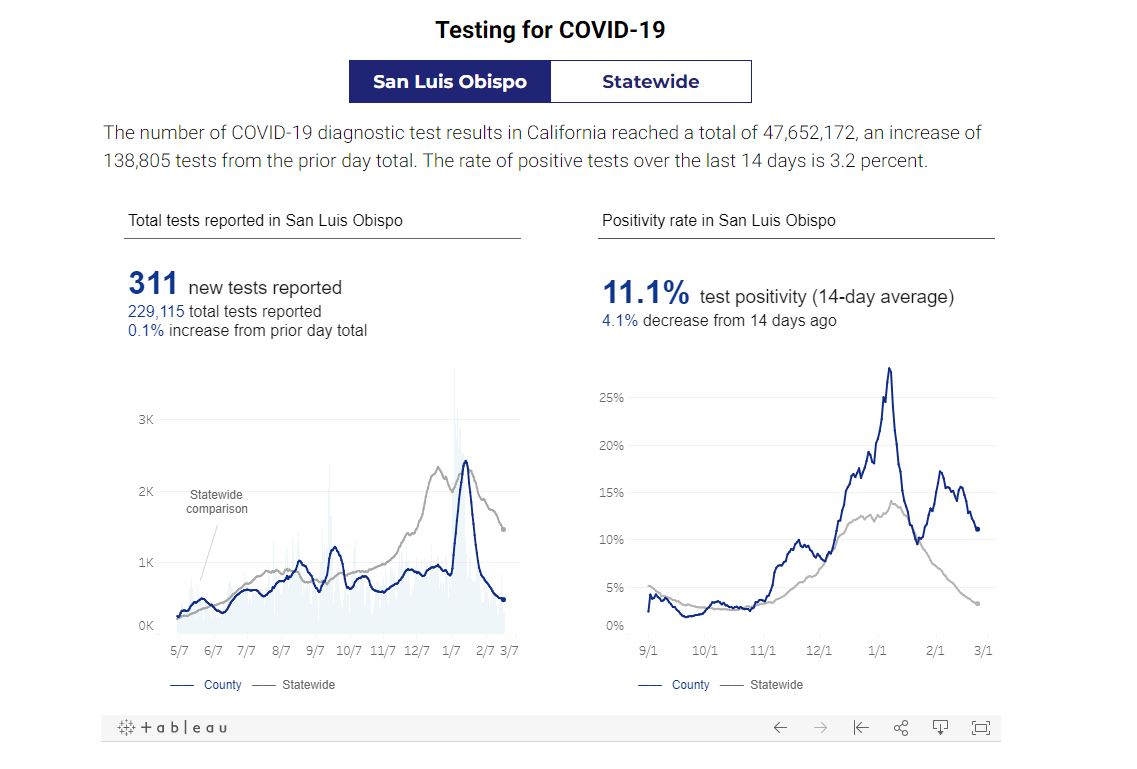
As stated, prior SLO County is currently still in the Purple Tier with a "widespread" risk of COVID-19 because of its current case rate. While the County's positivity rate and health equity metric meet or exceed the Orange Tier thresholds, the County's case rate only meets Purple Tier thresholds.
However, the State adjusts the County's overall case rate based on testing volume. As testing volume increases, the County's adjusted case rate decreases. Likewise, as testing volume decreases, the County's adjusted case rate can increase.
Borenstein stated that in order to get the County into the Red Tier, less than seven cases per 100,000 population per day, on average. Less than 8 percent between five and 8 percent test positivity for the County as a whole. And the same test positivity for the health equity core tier, the healthy places index lowest 25th percentile per vulnerability measures.
The other way that a county can progress forward is if those latter two measures the test positivity overall and the test positivity in that lowest 25th percentile quartile are even better in a tier, less restrictive. Less than 5 percent test positivity would put us in orange that can notwithstanding the higher case rate, allowing a county to move forward at tier. That happened for one week in our County, but it did not happen this week. The health equity quartile bumped up from 4.9 percent, 5.9 percent.
The County missed the opportunity to progress at this time. But Borenstein states that the good news is the metrics continue to go in the right direction. The county's case rate is coming down from 19.3 last week adjusted to 15.6, which shows that SLO County is continuing to move in the right direction in our case counts.